After firings, funding cuts, and a shooting, can a demoralized CDC workforce recover?
From
By
Jess Mador
After firings, funding cuts and a shooting, can a demoralized CDC workforce recover?
- Download
-
Embed
<iframe src="https://www.npr.org/player/embed/nx-s1-5742530/nx-s1-9685886" width="100%" height="290" frameborder="0" scrolling="no" title="NPR embedded audio player">
On the coffee table at her home in Atlanta, Sarah Boim has a pile of documents from her old job at the Centers for Disease Control and Prevention in Georgia. They are printouts of her own employment records.
Boim lost her job in the first big wave of CDC firings — when about 1,000 people were suddenly let go last February.

This story was produced in partnership with KFF Health News.
"This is the termination letter. I also printed off my performance review from 2024," she said. "I knew I wouldn't have access to it, and everything was so chaotic that I needed proof of what was happening."
Boim worked in the National Center for Environmental Health/Agency for Toxic Substances and Disease Registry, handling communications about radon, P-FAS contamination, lead poisoning and other health threats.
Reading her termination letter once again, she still can't believe what it says.
"The agency finds you are not fit for continued employment because your ability, knowledge, and skills do not fit the agency's current needs, and your performance has not been adequate to justify further employment at the agency."
"And that floored me," Boim said, "Because my performance was rated outstanding, and I even got a raise. It was just deeply insulting. So, I was more upset than I think I was prepared to be."

Former CDC employee Sarah Boim re-reads the termination letter, at her home in Atlanta. Boim lost her job in the first big round of firings in mid-February, 2025, just weeks into the second Trump administration. Jess Mador/WABE hide caption
The Trump administration later brought back some of the workers who were fired in the first round, but it has also continued to cut more staff and funding.
The CDC has been without a permanent director for more than six months. Recently the Trump administration said that Dr. Jay Bhattacharya will become the CDC's interim director for now — while also running the National Institutes of Health.
The uncertainty is just the latest in a year of disruption and dismissals at the Atlanta-based institution, where more than 3,000 public health workers are now gone. That includes staffers the Trump administration terminated, but also workers who accepted early retirements.
The Atlanta region continues to feel the ripple effects of the turmoil.
By the end of 2025 the CDC had lost roughly a quarter of its workforce, a KFF Health News analysis found.
Boim now works as a contractor in the health field, while also working a non-health-related freelance job.

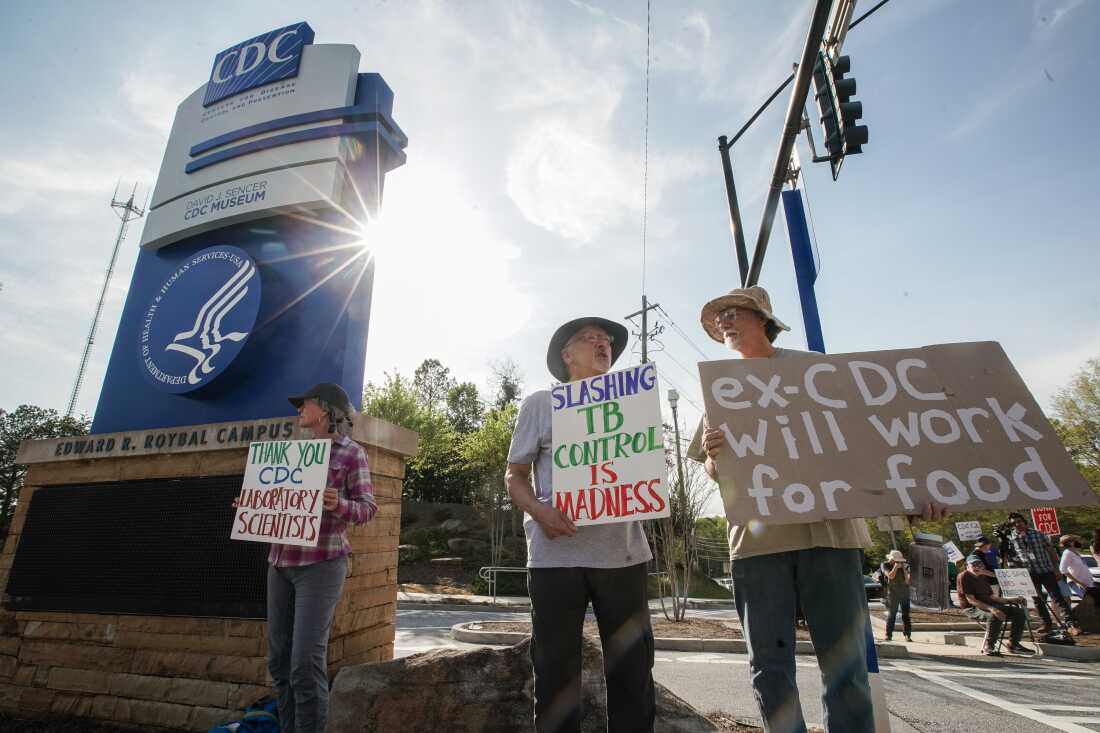
Dozens of protesters rallied across the street from the CDC campus in Atlanta, marking a year since the first mass firings began at the CDC under the Trump administration. The cuts affected thousands at multiple federal agencies, and began Feb. 13, 2025, and continued for several days after, leading many to call it the Valentine's Day Massacre. Jess Mador/WABE hide caption
Boim is still in mourning for the cuts at CDC, and how the loss of expertise and resources will trickle down to communities. A significant portion of CDC funding goes directly to states and local public health departments.
"In terms of health, it will cause generational harm, which always makes me tear up," Boim said. "The harm that's going to come to people that don't even know what CDC was protecting them from."
"But for Atlanta, there's a lot of us, there are thousands of CDC employees that live here," she added. "We are your friends, your neighbors, your family, and with the lost income, it has an impact on local businesses also."
At Sri Thai restaurant, across the street from the main CDC campus in Atlanta's DeKalb County, more than a third of the customers are CDC employees, said Manager Nathan Chanthavong.

Nathan Chanthavong manages Sri Thai restaurant in Atlanta, which saw a drop in catering orders in 2025 from the CDC campus across the street. Jess Mador/WABE hide caption
The restaurant saw a "small dip" in business in 2025 after the mass firings, and also during the government shutdown in the fall, he said.
"Typically, we would get a catering order for the CDC. We saw it less, less and less. It's not a really big impact, but catering is a big order, it is a lot of money," he said, "so it does affect us."
CDC falls under the purview of the U.S. Department of Health and Human Services. Asked about the cuts and attrition, HHS spokesman Andrew Nixon sent an email to NPR and KFF:
"HHS under the Biden administration became a bloated bureaucracy, growing its budget by 38% and its workforce by 17%. The Department continues to close wasteful and duplicative entities, including those that are at odds with the Trump administration's Make America Healthy Again agenda," he said.
Since the mass firings began, former CDC workers and their supporters have protested every Tuesday during the afternoon rush hour outside the CDC's main entrance.
On a recent Tuesday, a bigger crowd than usual — about 75 people — lined up along the sidewalk. A significant milestone had just occurred; it had been a year since the first massive cuts, which occurred in mid-February. CDC workers dubbed that the "Valentine's Day massacre."
Protestors waved handmade signs with slogans, such as 'We love CDC workers,' and 'Save Public Health.' Passing cars honked in solidarity.

People continue to leave flowers and notes at a memorial for DeKalb County Officer David Rose, who was killed in the Aug. 8 shooting outside the CDC headquarters in Atlanta. Jess Mador/WABE hide caption
Among the protesters was Ben McKenzie, who is still employed as a CDC researcher.
"It's been heartbreaking to see so many talented, able colleagues be forced out or leave," he said.
Current employees also need support, he said, especially after last summer, when a man opened fire Aug. 8 on CDC buildings. He killed DeKalb County Police Officer David Rose — before killing himself.
"I think we've all felt the emotional impact of being targets," McKenzie said. "Right now to work at CDC is in a lot of ways to be a target."

Multiple CDC employees have told KFF and NPR the federal government has yet to fully fix the damage to the windows and the buildings hit in last year's shooting.
McKenzie helps to run a mutual aid group, one of several that have sprung up in Atlanta. The group has distributed more than $200,000 to help former CDC workers with rent and other needs.
This story comes from NPR's health reporting partnership with WABE and KFF Health News.
- CDC
- Centers for Disease Control and Prevention
- federal layoffs
- doge
OpenAI’s adult mode will reportedly be smutty, not pornographic
The feature was delayed, reportedly due to internal concerns surrounding moderation and safeguarding children.
The feature was delayed, reportedly due to internal concerns surrounding moderation and safeguarding children.

OpenAI’s delayed “adult mode” for ChatGPT is expected to support saucy text conversations at launch, but not the chatbot’s ability to generate images, voice, or video. Speaking to The Wall Street Journal, an unnamed OpenAI spokesperson described content that will be provided by the upcoming feature as smut rather than pornography, allowing ChatGPT users to generate textual chats with adult themes.
The feature was initially announced in October, with OpenAI CEO Sam Altman claiming that the company had managed to mitigate enough of the “serious mental health issues“ with its AI model to relax safety restrictions and introduce “erotica for verified adults.” ChatGPT’s adult mode was expected to launch sometime this quarter, but OpenAI said earlier this month that it was delaying the rollout to focus on higher-priority tasks. A new release timeline has yet to be announced.
The delay was also due to internal concerns and technical challenges around safeguards for the feature, according to The Wall Street Journal’s reporting. A council of advisors selected by OpenAI warned the company in January that ChatGPT’s adult mode may be accessible to children and foster unhealthy emotional dependence on the chatbot, with one unnamed council member saying OpenAI risked creating a “sexy suicide coach.”
Related
- OpenAI fired exec who opposed ‘adult mode.’
- How chatbots are enabling AI psychosis
Content moderation issues have also contributed to the delays. Sources familiar with the matter told The Journal that OpenAI is struggling to lift ChatGPT’s restrictions on NSFW content while keeping more harmful scenarios off limits, such as those depicting nonconsensual behavior or child sexual abuse.
The age-prediction system that OpenAI developed to keep children away from erotica was also, at one point, misclassifying minors as adults about 12 percent of the time. Given ChatGPT attracts around 100 million users under 18 each week, that error rate could allow millions of minors into sexualized conversations with the chatbot. OpenAI’s age prediction algorithms show similar performance to the rest of the industry, an unnamed spokesperson told The Journal, but “will never be completely foolproof.”
Sticking to text-based conversations may make it easier for the ChatGPT-maker to navigate around rules like the UK’s Online Safety Act, which requires online platforms to enforce age verification for pornographic images, but not written erotica. It also contrasts with more visual NSFW experiences from rival AI providers, such as Grok’s “spicy” companions, with xAI’s Elon Musk announcing last week that Grok’s image and video generator is allowed to spit out anything that’s “allowed in an R-rated movie.”
Follow topics and authorsMost Popular
- European retailers yank popular headphones after study reports trace amounts of hormone-disrupting chemicals
- Meta is reportedly laying off up to 20 percent of its staff
- The $100,000 fee for H-1Bs is causing all sorts of problems
- MacBook Air M5 review: a small update for the ‘just right’ Mac
- The fast rise and epic fall of Clubhouse